
Which Mac for editing and grading? M1 to M6, Mac mini, Mac Studio Max or Ultra
2026 study: Apple M1 to M6 chips (Pro, Max, Ultra), Mac mini or Mac Studio, interactive comparison tool and advice for editing and grading.
The short answer (October 2026)
- HD and 4K editing on a tight budget: Mac mini M6 (from €1,049), with 24 or 32 GB of memory.
- Daily 4K and 6K editing, light grading: Mac mini M5 Pro (from €1,999), 48 or 64 GB.
- 4K and 6K grading, HDR, effects: Mac Studio M5 Max (from €2,999), 64 or 128 GB.
- 8K, heavy DaVinci Resolve projects, AI, multiple RAW streams: Mac Studio M5 Ultra (from €6,599), 256 GB or more.
- Intel Macs: avoid for a purchase. macOS 26 Tahoe is the last version that supports them, and DaVinci Resolve 21 now requires an Apple silicon Mac.
Starting prices published by Apple France. Every figure on this page is verified and sourced at the bottom.
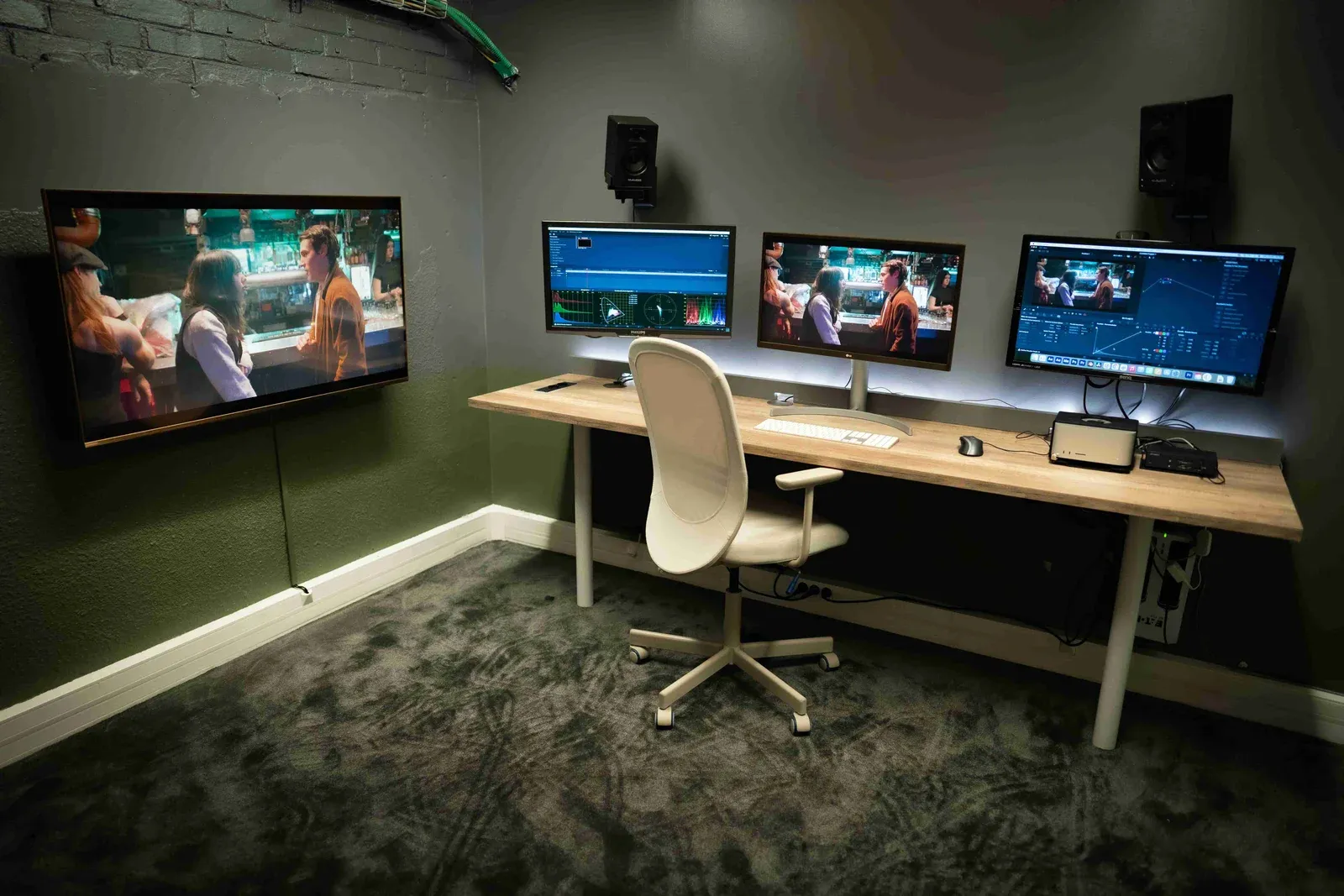
Want to try before you buy? Our Bastille suites run on Mac Studio M2 Ultra (24-core CPU, 76-core GPU, 192 GB): rent a suite by the half-day with your project and rushes.
Compare Macs side by side
Pick up to four models, from the 2019 Intel Mac Pro to the 2026 Mac Studio M5 Ultra. The best value in your selection is in bold.
Loading the comparison tool…
1. How to read an Apple chip
An Apple silicon chip puts the processor, graphics, memory and dedicated video circuits on a single package. For post-production, five things matter.
| Component | What it is | What it changes in post |
|---|---|---|
| CPU (cores) | The processor. Since 2026 Apple talks about "super", "performance" and "efficiency" cores. | Interface responsiveness, software decoding of codecs without hardware support, H.264 exports, conform, audio analysis. |
| GPU (cores) | The integrated graphics. | The engine of DaVinci Resolve: grading nodes, noise reduction, blur, effects, AI. More cores, more real-time nodes. |
| Unified memory | One memory pool shared by CPU and GPU. It cannot be upgraded after purchase. | 6K and 8K timelines, Fusion, temporal noise reduction, several apps open at once. The most important choice, and the only irreversible one. |
| Bandwidth | How fast that memory can be accessed (GB/s). | Heavy RAW playback, large EXR files, GPU processing. It roughly doubles at each tier: Pro, Max, Ultra. |
| Media engine | Dedicated circuits for video decode and encode, including ProRes. | Several ProRes, H.264 and HEVC streams without loading the CPU, much faster exports. Max chips have twice as many, Ultra chips four times as many. |
2. Base, Pro, Max, Ultra: what really changes
Each generation comes in four tiers. The tier often matters more than the generation: a 2023 M2 Max is still better suited to grading than a 2024 base M4.
| Tier | 2026 example | Max CPU / GPU | Max memory | Bandwidth | ProRes engines | External displays |
|---|---|---|---|---|---|---|
| Base | M6 (Mac mini, MacBook Pro 14, iMac) | 12 / 12 | 32 GB | 153 to 170 GB/s | 1 | up to 3 (Mac mini) |
| Pro | M5 Pro (Mac mini, MacBook Pro) | 18 / 20 | 64 GB | 307 GB/s | 1 | 3 |
| Max | M5 Max (Mac Studio, MacBook Pro) | 18 / 40 | 128 GB | 460 to 614 GB/s | 2 | 5 (Mac Studio) |
| Ultra | M5 Ultra (Mac Studio) | 36 / 80 | 512 GB | 1.2 TB/s | 4 | 8 |
Key point: Ultra chips only exist in the Mac Studio (and the Mac Pro, discontinued in March 2026). There was never an M4 Ultra: Apple went from M3 Ultra (2025) to M5 Ultra (2026).
3. History: from Intel to M6
| Date | Milestone | What changed for video |
|---|---|---|
| June 2005 | Apple announces the move from PowerPC to Intel | First Intel Macs in January 2006, first Mac Pro in August 2006. |
| Dec 2017 | iMac Pro (Xeon W up to 18 cores) | First Mac with the T2 chip. |
| Oct 2018 | Intel Mac mini (up to 6-core Core i7) | The T2 chip speeds up HEVC transcoding. |
| Dec 2019 | Mac Pro (Xeon W up to 28 cores, 1.5 TB memory) | Optional Afterburner card: hardware ProRes and ProRes RAW playback (no encoding). |
| June 2020 | Apple silicon transition announced | |
| Nov 2020 | M1 (MacBook Air, MacBook Pro 13, Mac mini) | Unified memory, hardware H.264 and HEVC decode. No ProRes engine yet. |
| Oct 2021 | M1 Pro and M1 Max (MacBook Pro 14 and 16) | First hardware ProRes and ProRes RAW engines. Apple quotes 7 streams of 8K ProRes on M1 Max. |
| Mar 2022 | M1 Ultra and the first Mac Studio | Two Max chips joined (UltraFusion), 800 GB/s, 18 streams of 8K ProRes 422 according to Apple. |
| June 2022 | M2 | The ProRes engine reaches the base chip. |
| June 2023 | M2 Ultra (Mac Studio, Mac Pro) | 192 GB, 22 streams of 8K ProRes 422. Transition complete: no Intel Mac left in the lineup. |
| Oct 2023 | M3, M3 Pro, M3 Max | First 3 nm chips, hardware ray tracing and AV1 decode. |
| Oct 2024 | M4, M4 Pro, M4 Max | Thunderbolt 5 on Mac (M4 Pro and Max). |
| Mar 2025 | M3 Ultra (Mac Studio) | Up to 512 GB at launch (256 GB since March 2026), Thunderbolt 5. |
| Sept 2025 | macOS 26 Tahoe | Announced as the last macOS release for Intel Macs. |
| Oct 2025 | M5 | A neural accelerator in every GPU core (AI), 3rd-generation ray tracing. |
| Mar 2026 | M5 Pro and M5 Max | "Super" cores, no efficiency cores on Pro and Max, up to 614 GB/s. The Mac Pro is discontinued with no successor. |
| Aug 2026 | M5 Ultra (Mac Studio) and M6 (Mac mini), on sale 22 September | M5 Ultra: four dies, 1.2 TB/s, 512 GB, 33 streams of 8K ProRes 422 according to Apple. M6: Apple's first 2 nm chip. macOS 27 runs only on Apple silicon. |
| Oct 2026 | M6 in the MacBook Pro 14 and iMac (shipping 6 November) | No M6 Pro or M6 Max announced so far. |
4. Every chip, from M1 to M6
| Chip | Released | Process | Max CPU | Max GPU | Max memory | Bandwidth | ProRes engines | AV1 / ray tracing | Thunderbolt |
|---|---|---|---|---|---|---|---|---|---|
| M1 | 2020 | 5 nm | 8 | 8 | 16 GB | 68 GB/s | 0 | no / no | TB3 |
| M1 Pro | 2021 | 5 nm | 10 | 16 | 32 GB | 200 GB/s | 1 | no / no | TB4 |
| M1 Max | 2021 | 5 nm | 10 | 32 | 64 GB | 400 GB/s | 2 | no / no | TB4 |
| M1 Ultra | 2022 | 5 nm | 20 | 64 | 128 GB | 800 GB/s | 4 | no / no | TB4 |
| M2 | 2022 | 5 nm (2nd gen) | 8 | 10 | 24 GB | 100 GB/s | 1 | no / no | TB3 |
| M2 Pro | 2023 | 5 nm (2nd gen) | 12 | 19 | 32 GB | 200 GB/s | 1 | no / no | TB4 |
| M2 Max | 2023 | 5 nm (2nd gen) | 12 | 38 | 96 GB | 400 GB/s | 2 | no / no | TB4 |
| M2 Ultra | 2023 | 5 nm (2nd gen) | 24 | 76 | 192 GB | 800 GB/s | 4 | no / no | TB4 |
| M3 | 2023 | 3 nm | 8 | 10 | 24 GB | 100 GB/s | 1 | yes / yes | TB3 |
| M3 Pro | 2023 | 3 nm | 12 | 18 | 36 GB | 150 GB/s | 1 | yes / yes | TB4 |
| M3 Max | 2023 | 3 nm | 16 | 40 | 128 GB | 300 to 400 GB/s | 2 | yes / yes | TB4 |
| M3 Ultra | 2025 | 3 nm | 32 | 80 | 256 GB (512 at launch) | 819 GB/s | 4 | yes / yes | TB5 |
| M4 | 2024 | 3 nm (2nd gen) | 10 | 10 | 32 GB | 120 GB/s | 1 | yes / yes | TB4 |
| M4 Pro | 2024 | 3 nm (2nd gen) | 14 | 20 | 64 GB | 273 GB/s | 1 | yes / yes | TB5 |
| M4 Max | 2024 | 3 nm (2nd gen) | 16 | 40 | 128 GB | 410 to 546 GB/s | 2 | yes / yes | TB5 |
| M5 | 2025 | 3 nm (3rd gen) | 10 | 10 | 32 GB | 153 GB/s | 1 | yes / yes | TB4 |
| M5 Pro | 2026 | 3 nm (3rd gen) | 18 | 20 | 64 GB | 307 GB/s | 1 | yes / yes | TB5 |
| M5 Max | 2026 | 3 nm (3rd gen) | 18 | 40 | 128 GB | 460 to 614 GB/s | 2 | yes / yes | TB5 |
| M5 Ultra | 2026 | not stated | 36 | 80 | 512 GB | 1,200 GB/s | 4 | yes / yes | TB5 |
| M6 | 2026 | 2 nm | 12 | 12 | 32 GB | 153 to 170 GB/s | 1 | yes / yes | TB4 |
ProRes engines: number of ProRes encode/decode engines listed by Apple. The base M1 lists none. Bandwidth: the lower figure is for the version with fewer GPU cores.
5. Mac mini, Mac Studio Max or Mac Studio Ultra in 2026
| Mac mini M6 | Mac mini M5 Pro | Mac Studio M5 Max | Mac Studio M5 Ultra | |
|---|---|---|---|---|
| Starting price (France) | €1,049 | €1,999 | €2,999 | €6,599 |
| CPU / GPU | 12 / 12 | 15 / 16, up to 18 / 20 | 18 / 32 or 40 | 30 / 64, up to 36 / 80 |
| Memory | 16 GB, up to 32 GB | 24 GB, up to 64 GB | 36 GB, up to 128 GB | 96 GB, up to 512 GB |
| Bandwidth | 153 to 170 GB/s | 307 GB/s | 460 to 614 GB/s | 1.2 TB/s |
| Media engine | 1 decode, 1 encode, 1 ProRes | 1 / 1 / 1 | 1 / 2 / 2 | 2 / 4 / 4 |
| Ports | 3 Thunderbolt 4, HDMI, 2.5 Gb Ethernet (10 Gb option) | 3 Thunderbolt 5, HDMI, 2.5 Gb (10 Gb option) | 4 Thunderbolt 5 at the back, 10 Gb Ethernet, HDMI 2.1, SD card slot | 6 Thunderbolt 5 (2 at the front), 10 Gb Ethernet, HDMI 2.1, SD |
| External displays | up to 3 | up to 3 | up to 5 | up to 8 |
| For whom | HD and 4K editors, assistants, logging | 4K and 6K editors, simple grading | Colourists, motion design, HDR | 8K, multicam RAW, heavy VFX, local AI |
The Mac Pro was discontinued on 26 March 2026 and Apple does not plan a new one: the Mac Studio is now the most powerful Mac. A note for sound: according to Blackmagic Design, the Fairlight Audio Accelerator card and Fairlight Audio Interface are supported on Intel Macs only.
6. What about Intel Macs?
| Mac | Top configuration | Video | Last macOS |
|---|---|---|---|
| Mac Pro 2019 | 28-core Xeon W, up to 1.5 TB, up to 4 AMD GPUs (MPX) | Optional Afterburner: ProRes and ProRes RAW playback (6 streams of 8K ProRes RAW according to Apple), no encoding | macOS 26 Tahoe |
| iMac Pro 2017 | 18-core Xeon W, 256 GB, Radeon Pro Vega 64X | No ProRes engine | macOS 15 Sequoia |
| Mac mini 2018 | 6-core Core i7, 64 GB, Intel UHD 630 | T2 for HEVC, no hardware HEVC 4:2:2 decode | macOS 15 Sequoia |
| MacBook Pro 16-inch 2019 | 8-core Core i9, 64 GB, Radeon Pro 5600M | No hardware HEVC 4:2:2 decode | macOS 26 Tahoe |
A well-specced 2019 Mac Pro is still capable, but its future is limited: no new macOS after Tahoe, and software follows. DaVinci Resolve 21 requires an Apple silicon Mac and Final Cut Pro reserves some features for Apple chips. The main day-to-day trap: H.264 and HEVC 4:2:2 10-bit files from recent hybrid cameras (Sony, Canon, Panasonic, Fujifilm), which Intel Macs cannot decode in hardware. On Apple silicon, Adobe enabled this hardware decoding in Premiere Pro as early as August 2021.
7. Which Mac for which job
| Job | Comfortable minimum | Ideal | Suggested memory |
|---|---|---|---|
| HD editing, proxies, logging | Mac mini M4 or M6 | Mac mini M6 | 24 to 32 GB |
| 4K editing (ProRes, H.264, HEVC) | Mac mini M4 Pro | Mac mini M5 Pro | 48 to 64 GB |
| Feature editing on Avid Nexis | Mac mini M5 Pro (10 Gb Ethernet) | Mac Studio M5 Max | 64 GB |
| 4K and 6K SDR grading | Mac Studio M4 Max | Mac Studio M5 Max, 40-core GPU | 64 to 128 GB |
| HDR, Dolby Vision, noise reduction | Mac Studio M5 Max | Mac Studio M5 Ultra | 128 GB or more |
| 8K, multicam RAW, VFX, AI (Magic Mask, upscaling) | Mac Studio M3 Ultra | Mac Studio M5 Ultra | 256 GB or more |
| Sound editing and mixing | Mac mini M5 Pro | Mac Studio M5 Max | 32 to 64 GB |
Recommendations from the ForCut team, based on our day-to-day practice. Vendors only publish minimums: Blackmagic Design asks for 16 GB for the AI tools of DaVinci Resolve 21 and 32 GB for background rendering; Adobe recommends 16 GB and an M1 Pro or newer chip for Premiere Pro.
8. Five mistakes to avoid
- Skimping on memory. It can never be added later. Better one chip tier lower and more memory.
- Grading on a base chip. GPU and bandwidth make the difference in Resolve: aim for at least a Max chip.
- Forgetting displays. An M6 Mac mini drives 3 external displays, an M5 Max Mac Studio 5, an M5 Ultra 8.
- Ignoring the network. To work on shared storage (Avid Nexis, NAS), take the 10 Gb Ethernet option on Mac mini: it is standard on Mac Studio.
- Buying a used Intel Mac for video. Cheaper, but without ProRes engines, without hardware 4:2:2 decode and without a macOS future.
Work on a Mac Studio Ultra without buying one
At ForCut, our editing and grading suites at Studio Bastille run on Mac Studio M2 Ultra (24-core CPU, 76-core GPU, 192 GB, 10 Gb Ethernet), with DaVinci Resolve Studio, Avid Media Composer and Premiere Pro. 24/7 access, from €80 incl. VAT per half-day. At République, five suites on an Avid Nexis SAN.
Sources
- Apple: Mac Studio M5 Max and M5 Ultra (August 2026), Mac mini M6 and M5 Pro, M6 and M5 Ultra chips, Mac Studio specs, Mac mini specs, MacBook Pro specs.
- Apple: announcements of M1 Pro and M1 Max, M1 Ultra, M2 Ultra, M3, M4 Pro and M4 Max, M5; tech specs for Mac Studio 2022, Mac Studio 2023, Mac Studio 2025, Mac Pro 2019, Afterburner card, macOS Tahoe compatible Macs.
- Software: DaVinci Resolve 21 requirements, Fairlight hardware, Premiere Pro requirements, Adobe, 4:2:2 10-bit decode on Apple silicon, Final Cut Pro.
- Press: Mac Pro discontinued (MacRumors), end of the 512 GB M3 Ultra option, M6 in the MacBook Pro 14, Mac transition to Apple silicon (Wikipedia), Intel Quick Sync (Wikipedia).
Data verified on 31 October 2026. Prices: Apple France starting prices at announcement.
FAQ
Which Mac for DaVinci Resolve in 2026?
For 4K and 6K grading, a Mac Studio M5 Max (from €2,999) with 64 to 128 GB of memory. For 8K, heavy HDR or AI, a Mac Studio M5 Ultra (from €6,599). DaVinci Resolve 21 requires an Apple silicon Mac.
Mac mini or Mac Studio for video editing?
A Mac mini M6 or M5 Pro is enough for HD and 4K editing. The Mac Studio brings a Max or Ultra chip: two to four times more ProRes engines, more GPU cores, up to 512 GB of memory and up to 8 displays.
What is the difference between M5 Max and M5 Ultra?
The M5 Ultra doubles the GPU (80 cores vs 40) and the ProRes engines (4 vs 2), goes up to 512 GB of memory vs 128 GB and 1.2 TB/s of bandwidth vs 614 GB/s. Apple quotes 33 simultaneous streams of 8K ProRes 422.
How much memory for 4K editing?
We suggest 48 to 64 GB for 4K editing and 64 to 128 GB for grading. Apple silicon memory cannot be added after purchase: it is the most important choice.
Is an Intel Mac still usable for video?
Yes to finish projects, but not as a purchase: macOS 26 Tahoe is the last compatible version, DaVinci Resolve 21 requires Apple silicon, and Intel Macs cannot hardware-decode the HEVC 4:2:2 10-bit files of hybrid cameras.
Is there an M6 Pro or M6 Max?
Not as of 31 October 2026. The M6 ships in the Mac mini, the 14-inch MacBook Pro and the iMac. For Pro, Max and Ultra chips, the current generation is M5.
Related guides
Post-producing in Paris?
At Studio Bastille (Paris 12), the editing suite starts at €80 and the grading suite at €110 per half-day (incl. VAT), with 24/7 self access and Mac Studio M2 Ultra machines. Studio République (Paris 10) offers five rooms on an Avid Nexis SAN, including 5.1 sound and a screening room, on quote. ForCut is eligible for the TRIP tax rebate.